The IISER Aptitude Test (IAT) 2026 is the primary entrance channel for premier science institutes in India, including the seven Indian Institutes of Science Education and Research (IISERs), IISc Bangalore, and IIT Madras. To succeed, candidates must master a broad curriculum spanning four core subjects: Biology, Chemistry, Mathematics, and Physics.
IAT 2026 Exam Pattern at a Glance
Before diving into the topics, it is essential to understand the test structure:
- Total Questions: 60 (15 questions per subject).
- Maximum Marks: 240.
- Marking Scheme: for a correct answer, for an incorrect answer, and for unattempted questions.
- Duration: 180 minutes (3 hours).
- Mode: Computer-Based Test (CBT).
1. Biology Syllabus
The Biology section covers a wide range of topics from fundamental cell biology to complex ecological systems.
- Diversity in the Living World: Taxonomic categories, biological classification (Five Kingdoms), and the plant and animal kingdoms.
- Structural Organisation: Anatomy and morphology of flowering plants; structural organization in animals (focused on the Frog).
- Cell: Structure and Functions: Cell theory, prokaryotic and eukaryotic cell structures, biomolecules, and the cell cycle (Mitosis and Meiosis).
- Plant Physiology: Photosynthesis, respiration in plants, and plant growth regulators.
- Human Physiology: Breathing, circulation, excretory products, locomotion, neural control, and chemical integration.
- Reproduction: Sexual reproduction in flowering plants, human reproduction, and reproductive health.
- Genetics and Evolution: Mendelian inheritance, molecular basis of inheritance (DNA/RNA), and the origin of life.
- Biology in Human Welfare: Human health and diseases, microbes in household and industrial products.
- Biotechnology: Principles, processes, and applications in medicine and agriculture.
- Ecology: Organisms and populations, ecosystems, and biodiversity conservation.

IISER IAT 2026-2027 (Set of 5 Books) Indian Institute of Science Education and Research Aptitude Test
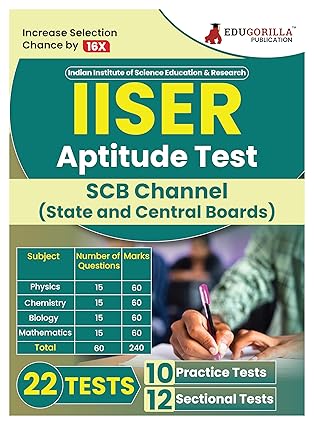
IISER Aptitude Test 2022 - SCB Channel | 10 Full-length Mock Tests + 12 Sectional Tests | Free Access to Online Tests
2. Chemistry Syllabus
The Chemistry syllabus is divided into Physical, Inorganic, and Organic Chemistry, emphasizing conceptual clarity and numerical application.
- Physical Chemistry:
- Basic concepts (mole concept, stoichiometry).
- Atomic structure and quantum mechanical models.
- Thermodynamics (Enthalpy, Spontaneity, and Gibbs Energy).
- Chemical Equilibrium and Ionic Equilibrium.
- Redox reactions and Electrochemistry.
- Chemical Kinetics (Rate laws and collision theory).
- Inorganic Chemistry:
- Periodic classification and periodicity.
- Chemical bonding and molecular structure ( and ).
- - and -block elements; Coordination compounds.
- Organic Chemistry:
- Nomenclature, isomerism, and reaction mechanisms.
- Hydrocarbons (Alkanes, Alkenes, Alkynes, and Aromatics).
- Functional groups: Haloalkanes, Alcohols, Phenols, Ethers, Aldehydes, Ketones, and Carboxylic Acids.
- Nitrogen-containing organic compounds (Amines).
- Biomolecules (Carbohydrates, Proteins, and Nucleic Acids).
3. Mathematics Syllabus
Mathematics requires a strong grasp of both algebraic logic and calculus.
- Sets and Logic: Relations, functions, and their graphical representations.
- Algebra: - Permutations and Combinations.
- Binomial Theorem.
- Complex numbers in the form and the Argand plane.
- Quadratic equations and linear inequalities.
- Matrices and Determinants (up to matrices).
- Trigonometry: Inverse trigonometric functions and identities.
- Coordinate Geometry: Straight lines, circles, and conic sections (Parabola, Ellipse, Hyperbola).
- Calculus:
- Limits and continuity of functions.
- Differentiation and its applications (tangents, maxima/minima).
- Integration: Definite and indefinite integrals.
- Differential Equations: First-order and first-degree equations.
- Vectors and 3D Geometry: Dot/cross products and shortest distance between lines.
- Statistics and Probability: Variance, standard deviation, and Bayes’ Theorem.
4. Physics Syllabus
The Physics section tests fundamental principles of the physical world, from classical mechanics to modern physics.
- Mechanics: Units and measurements, motion in a straight line/plane, laws of motion (), and systems of particles (rotational motion).
- Energy and Gravitation: Work, energy, power, and Kepler’s laws of planetary motion.
- Properties of Matter: Mechanical properties of solids and fluids (Bernoulli’s principle, viscosity).
- Thermodynamics: Thermal properties, laws of thermodynamics, and kinetic theory of gases.
- Oscillations and Waves: Simple Harmonic Motion () and the principle of superposition.
- Electromagnetism: - Electrostatics (Gauss's law, capacitance).
- Current electricity (Ohm’s law, Kirchhoff’s rules).
- Moving charges and magnetism (Biot-Savart law).
- Electromagnetic induction and Alternating Current ().
- Optics: Ray optics (mirrors/lenses) and Wave optics (Interference/Diffraction).
- Modern Physics: Dual nature of radiation, atomic models, and nuclear physics.
- Semiconductors: junction diodes and simple circuits.
Preparation Tips for IAT 2026
- NCERT is Key: The syllabus is closely aligned with Class 11 and 12 NCERT textbooks.
- Practice Mock Tests: Utilize the official Mock Tests to get familiar with the CBT interface.
- Time Management: Since you have 180 minutes for 60 questions, aim to spend no more than 3 minutes per question.
- Conceptual Focus: IAT questions often test the depth of understanding rather than rote memorization.