Quick Overview (Must-Know for Exams)
| Feature | Details |
|---|---|
| National Framework | National Perspective Plan (NPP), 1980 |
| Nodal Agency | National Water Development Agency (NWDA) |
| Ministry | Ministry of Jal Shakti (formerly Ministry of Irrigation) |
| Programme | Inter-Basin Water Transfer (IBWT), announced 2002 |
| Total National Links | 30 links (16 Peninsular + 14 Himalayan) |
| Key Projects in Maharashtra | Damanganga-Pinjal, Par-Tapi-Narmada, Nar-Par-Girna, Jalgaon River Linking, Wainganga-Nalganga |
Introduction: Why Does Maharashtra Need River Linking?
Maharashtra — India's economic powerhouse — is paradoxically one of its most water-stressed states. While the Konkan coast receives over 3,000 mm of rainfall annually, the Marathwada and Vidarbha regions frequently suffer from devastating droughts, farmer suicides, and severe drinking water crises. The Western Ghats act as a climatic barrier: rivers on the western slopes rush into the Arabian Sea, while the eastern plateau waits for rainfall that often never comes adequately.
The core problem is simple: water is abundant in the wrong place. The solution, however, is enormously complex — river interlinking.
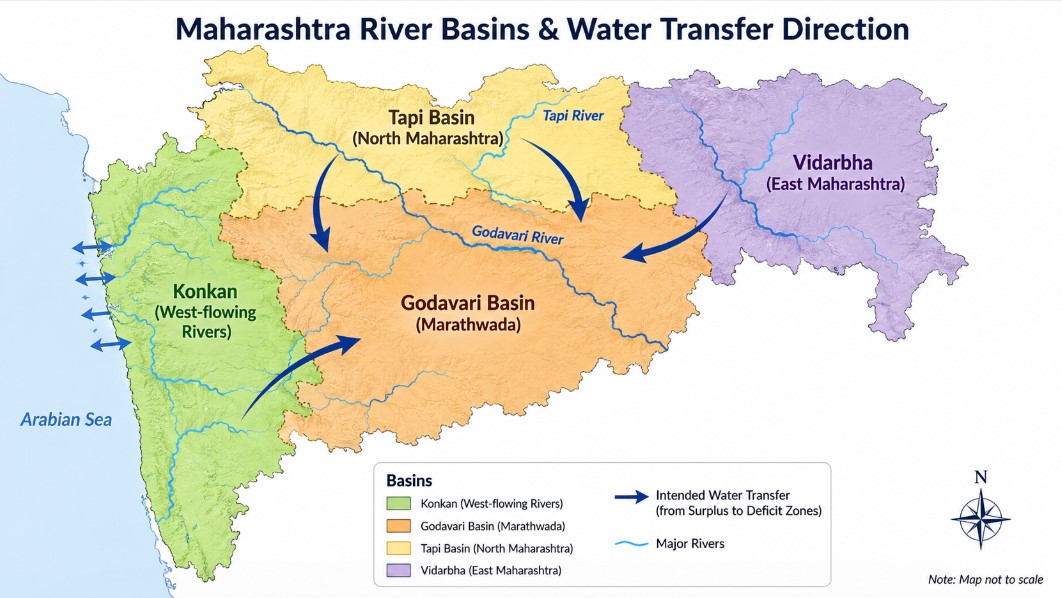
River interlinking involves connecting rivers through a system of reservoirs, canals, tunnels, and pumping stations to transfer surplus water from flood-prone basins to drought-prone regions. Think of it as building a vast underground and overground water highway — one that redirects life where it is most needed.
National Framework: The Big Picture First
Before diving into Maharashtra-specific projects, let's understand the national blueprint — because many exam questions test this context.
National Perspective Plan (NPP), 1980
The Ministry of Irrigation (now Jal Shakti) proposed the NPP in August 1980 to harness India's water potential. The plan was visionary: identify river basins with surplus water and link them to deficit basins through an engineered network.
National Water Development Agency (NWDA)
NWDA was constituted in 1982 under the Ministry of Water Resources (now Jal Shakti) to carry out:
- Water balance studies and surveys
- Toposheet analysis for reservoir sites and link alignments
- Feasibility reports for interlinking proposals
Inter-Basin Water Transfer (IBWT) Programme, 2002
The Government of India formally announced IBWT in 2002, envisioning 30 inter-basin links — 16 under the Peninsular Component and 14 under the Himalayan Component. Maharashtra features prominently in the Peninsular Component.
Exam Tip: The Ken-Betwa Link Project is India's first river interlinking project to be taken up under the National Perspective Plan. Maharashtra's projects come under the Peninsular Component.
What is River Interlinking? (Conceptual Clarity)
River interlinking — also called Inter-Basin Water Transfer (IBWT) — is a large-scale civil engineering approach to redistribute water resources.
Key mechanisms include:
- Gravity canals — water flows naturally downhill without pumping
- Pressure/gravity tunnels — water passes through mountain terrain via tunnels
- Pumped lift schemes — water is mechanically lifted across elevation differences
- Reservoirs (dams) — act as storage nodes in the network
The fundamental principle is transferring water from "donor" basins (high rainfall, flood-prone) to "recipient" basins (low rainfall, drought-prone) through a connected infrastructure grid.
Major River Linking Projects in Maharashtra
1. Damanganga–Pinjal River Linking Project
This is the most exam-important project for Maharashtra. Learn it thoroughly.
Background
Mumbai — India's financial capital and a city of over 20 million — faces a perpetual water crisis. Its water supply infrastructure, built during the colonial era, was designed for a far smaller population. The Damanganga-Pinjal project is the modern answer to Mumbai's thirst.
What Does It Do?
The project proposes to transfer surplus water from the Damanganga river basin — located in north Maharashtra and Dadra & Nagar Haveli — westward to the Pinjal reservoir in the Vaitarna basin, which then supplies Mumbai.
Key Technical Details
| Parameter | Detail |
|---|---|
| Water source | Damanganga basin (Bhugad & Khargihill dam sites) |
| Destination | Pinjal Reservoir → Greater Mumbai |
| Tunnel 1 | Bhugad–Khargihill: 16.85 km |
| Tunnel 2 | Khargihill–Pinjal: 25.70 km |
| Annual water transfer | ~909 Million Cubic Meters (MCM) |
| Daily water supply addition | 2,451 million litres to Mumbai |
| Dam on Damanganga | 826.60 m long composite dam |
| Project cost | ~₹3,008 crores (2015-16 figures) |
| Executing agencies | MMRDA (Mumbai Metropolitan Region Development Authority) & MCGM (Municipal Corporation of Greater Mumbai) |
| Water security horizon | Mumbai's water needs until 2060 |
| Trilateral agreement | Signed in 2010 between Gujarat, Maharashtra & Central Government |
| DPR approved | January 2015 |
Why is it significant?
Mumbai draws water from the Vaitarna and Ulhas river systems. But rapid urbanisation has pushed demand far beyond supply. The Damanganga-Pinjal project adds a new source — tapping the relatively water-rich Damanganga basin — giving Mumbai a lifeline for the next four decades.
Exam Tip: The Pinjal reservoir lies in the Vaitarna basin, not directly on the Damanganga river. The project uses tunnels to connect three reservoirs: Bhugad → Khargihill → Pinjal.
2. Par–Tapi–Narmada River Linking Project
Overview
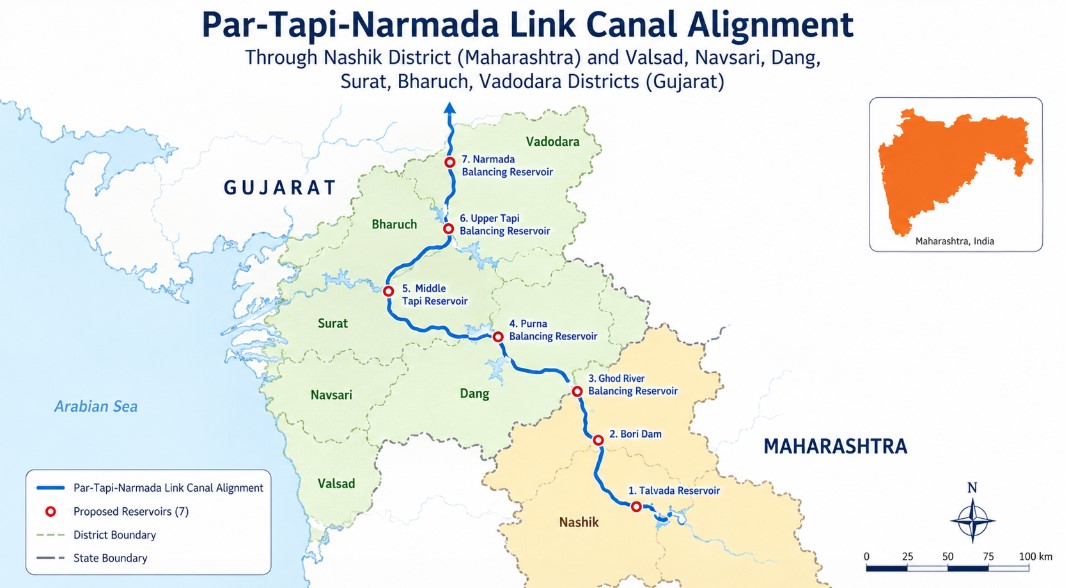
While the Damanganga-Pinjal project primarily benefits Maharashtra (Mumbai), the Par-Tapi-Narmada (PTN) link is a shared project that spans Maharashtra's Nashik district and southern Gujarat. Its primary beneficiary in terms of irrigation is Gujarat (Saurashtra and Kutch), but its roots lie in Maharashtra's Western Ghats rivers.
Core Concept
The Par, Tapi (Tapti), and several small west-flowing rivers of the Western Ghats carry enormous volumes of water during monsoons — water that currently flows unused into the Arabian Sea. The PTN project proposes to intercept this surplus and channel it eastward through a 395 km-long canal network to water-deficit areas.
Key Technical Details
| Parameter | Detail |
|---|---|
| Rivers involved | Par, Tapi (Tapti), Auranga, Ambika, Purna |
| Reservoirs | 7 reservoirs total (1 in Maharashtra + 6 in Gujarat) |
| Maharashtra component | Jheri Dam – Nashik district |
| Gujarat reservoirs | Mohankavchali, Paikhed, Chasmandva, Chikkar, Dabdar, Kelwan (Valsad & Dang districts) |
| Canal length | ~395 km (including 33 km feeder canals) |
| Par-Tapi canal reaches | Valsad, Navsari, Dang, Surat (Gujarat) |
| Tapi-Narmada canal reaches | Surat, Bharuch, Vadodara (Gujarat) |
| DPR completed | August 2015 (by NWDA) |
| Target beneficiaries | Tribal areas, Dang & Valsad (Gujarat), Nashik (Maharashtra) |
Benefits for Maharashtra
- Provides potable water and irrigation to tribal communities in Nashik district
- Benefits Nashik district's drought-affected talukas
- Helps in transferring water from the water-surplus Western Ghats region
Exam Tip: Most of the PTN project geographically falls in Gujarat. The only Maharashtra dam in this project is the Jheri Dam in Nashik. Both PTN and Damanganga-Pinjal were linked in negotiations between Maharashtra and Gujarat — Gujarat insisted both be signed together.
3. Nar–Par–Girna Valley Intra-State River Linking Project
What Makes This Project Unique?
Unlike Damanganga-Pinjal (inter-state), the Nar-Par-Girna link is an entirely intra-state project within Maharashtra — meaning it doesn't require inter-state negotiations or consent from other state governments. This makes it faster to implement and politically less contested.
Core Logic
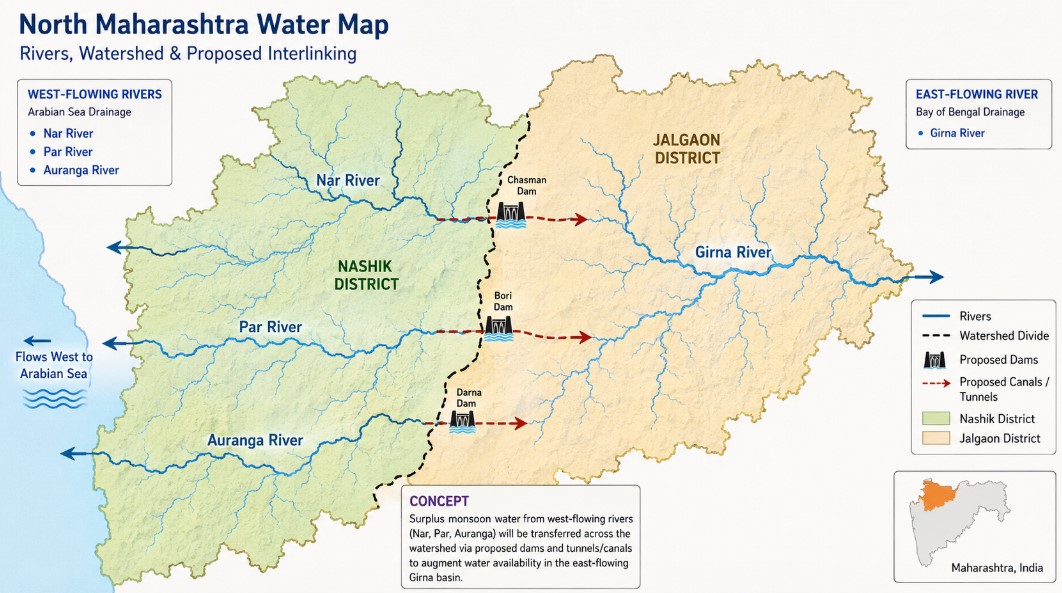
The Nar, Par, Auranga, and Ambika rivers of north Maharashtra flow westward into the Arabian Sea, carrying water that is surplus during monsoons. Just across the watershed, the Girna River (a tributary of the Tapi/Tapti) flows eastward through Nashik and Jalgaon — regions severely water-stressed.
The project proposes to intercept and redirect 534 MCM (10.64 TMC) of westward-flowing surplus water eastward into the Girna basin.
Key Technical Details
| Parameter | Detail |
|---|---|
| Source rivers | Nar, Par, Auranga, Ambika (west-flowing) |
| Destination river | Girna River (Tapi basin, east-flowing) |
| Water diverted | 534 MCM (10.64 TMC) |
| Number of new dams | 9 dams (in Surgana taluka, Nashik) |
| Pump lift height | 305 metres to Chankapur Dam (Tapi basin) |
| Area irrigated | 49,516 hectares total |
| — Nashik (Surgana, Kalvan, Deola, Malegaon talukas) | 32,492 ha |
| — Jalgaon (Bhadgaon, Erandol, Chalisgaon) | 17,024 ha |
| Project cost | ₹7,015 crores |
| Governor's approval | August 10, 2024 |
| Cabinet approval | August 25, 2024 |
| SLTAC approval | March 15, 2023 |
| NWDA feasibility | Completed |
### 4. Wainganga–Nalganga River Linking Project (Vidarbha's Lifeline)Exam Tip: The Nar-Par-Girna project was originally revived in 2022 by the Shiv Sena-BJP government with ₹7,015 crores allocation. It received Cabinet clearance in August 2024 under CM Eknath Shinde. CM Devendra Fadnavis has since made it a priority project.
The Crisis it Addresses
Western Vidarbha — comprising districts like Buldhana, Washim, Yavatmal, Akola — suffers from acute water scarcity despite being adjacent to the relatively water-rich eastern Vidarbha. The Wainganga River (a Godavari tributary) in eastern Vidarbha carries significant surplus flows from Madhya Pradesh's Mahadeo Hills. The Nalganga River (Purna-Tapi basin) in western Vidarbha is chronically water-deficit.
Project Design
The project transfers water from the Gosikhurd National Irrigation Project on the Wainganga to the Nalganga basin via a massive canal network.
| Parameter | Detail |
|---|---|
| Source | Wainganga River (Godavari basin) via Gosikhurd reservoir |
| Destination | Nalganga River (Purna-Tapi basin) |
| Canal network | 426.52 km canal |
| New canals | 400–500 km of new canals |
| Area irrigated | 10 lakh acres (approximately 3.71 lakh hectares) in 6 districts |
| Beneficiary districts | 6 districts of western Vidarbha |
| Project cost | ₹87,342.86 crores |
| NWDA feasibility | 2018 feasibility report |
| Cabinet approval | 2024 |
### 5. Jalgaon River Linking Project (The Local Model)This is the most expensive river linking project approved in Maharashtra, aimed at making western Vidarbha drought-free.
While the above projects are mega-scale, the Jalgaon River Linking Project represents a grassroots-level, cost-effective approach — and is often cited as a model of participatory water management.
How it Works
The Bori River flows 35 km eastward before reaching the Bori Dam in Jalgaon district. Through a series of local canals, the Bori Dam is connected to the Girna Dam. This creates a network that redistributes water across the drought-stricken areas of Jalgaon.
Key Features
- Addresses drinking water scarcity in Jalgaon's drought-affected talukas
- Uses cost-effective, gravity-based canal distribution
- Involved local participation and community engagement
- Balanced environmental concerns with human needs
Three Pillars of Its Success
- Cost-effective engineering — minimised expensive infrastructure
- Participatory approach — local communities involved in planning and implementation
- Environmental sensitivity — addressed ecological concerns during design
6. Damanganga–Vaitarna–Godavari & Damanganga–Ekdare–Godavari Projects
These two projects are part of Maharashtra's ambitious 2024 water grid vision announced by CM Devendra Fadnavis.
Key highlights:
- Water from Damanganga basin (Konkan) is pumped and released at Jharlipada in Dindori (Nashik)
- From there, water travels via Waghad Dam and through the Godavari River to reach Jayakwadi Dam in Marathwada
- Together, they aim to provide 25.60 billion cubic feet of water to Marathwada
- Administrative approval: ₹2,213.53 crore
- Governor's in-principle approval: October 6, 2024
- Total irrigation benefit: 12,753 hectares
Maharashtra's Four-Project Vision: 2024 Announcement
On December 19, 2024, CM Devendra Fadnavis, in the Nagpur Legislative Assembly session, declared that Maharashtra would become drought-free through four major river linking projects:
| Project | From → To | Key Benefit |
|---|---|---|
| Wainganga–Nalganga | Godavari → Tapi basin | Western Vidarbha (₹87,342 cr) |
| Nar–Par–Girna | West-flowing → Girna | Nashik & Jalgaon (₹7,015 cr) |
| Damanganga–Vaitarna–Godavari | Konkan → Marathwada | Jayakwadi Dam supply |
| Damanganga–Ekdare–Godavari | Konkan → Marathwada | Water grid extension |
Additionally, the overall framework allocates:
- 31.60 billion cubic feet of water from Konkan → Mumbai city
- 25.60 billion cubic feet from Konkan → Marathwada (Godavari basin)
- 10.76 billion cubic feet from Konkan → Tapi basin
International funding: The Asian Infrastructure Investment Bank (AIIB), Korean Exim Bank, and AFD (Agence Française de Développement) have positively responded to funding requests for these projects.
Significance of River Linking Projects in Maharashtra
River linking is not merely an engineering exercise — it has profound economic, social, and strategic implications:
1. Reducing Regional Imbalances
Maharashtra's water inequality — between the water-rich Konkan and water-poor Marathwada/Vidarbha — is one of the most glaring developmental disparities in India. River linking directly addresses this structural inequity.
2. Agricultural Transformation
Irrigation expansion — from the Nar-Par-Girna project alone covering 49,516 hectares — can double or triple farm yields in North Maharashtra, reducing farmer distress and outmigration.
3. Urban Water Security
The Damanganga-Pinjal project secures Mumbai's water supply until 2060, providing certainty for one of Asia's largest urban agglomerations.
4. Flood Mitigation
By diverting monsoon surpluses from flood-prone western rivers, these projects can simultaneously reduce flooding in the Konkan and drought in the Deccan.
5. Employment and Tribal Development
Construction and operation of dams, tunnels, and canals create employment. The Par-Tapi-Narmada project specifically targets tribal areas in Nashik and Gujarat.
6. Hydropower Potential
Gravity-run tunnels and canals can generate hydroelectric power, contributing to Maharashtra's renewable energy goals.
7. Drinking Water Access
Projects like the Jalgaon River Linking and Nar-Par-Girna prioritise potable water supply to villages and tribal hamlets that currently depend on tankers during summers.
Challenges and Concerns
Despite the compelling rationale, river linking faces significant hurdles — both technical and non-technical:
1. Ecological Disruption
Diverting river flows alters downstream ecosystems, affects wetlands, and can disrupt aquatic biodiversity. Rivers are not just water pipes — they are living systems.
2. Displacement and Rehabilitation
Large dams and reservoirs submerge villages and forests. Rehabilitation of displaced communities — often tribal — remains a complex, contentious issue.
3. Inter-State Disputes
Water-sharing between states is politically sensitive. The Maharashtra-Gujarat negotiations over Damanganga-Pinjal and Par-Tapi-Narmada took decades. States downstream of donor rivers resist diversion.
4. Financial Enormity
The combined cost of Maharashtra's ongoing river linking projects exceeds ₹1 lakh crore — requiring sustained government commitment, international financing, and multi-decade execution.
5. Bureaucratic and Regulatory Complexity
Multiple approvals are needed: NWDA feasibility clearance, state-level technical advisory committee (SLTAC) review, Cabinet approval, Governor's in-principle approval, environmental clearances, and DPR finalisation.
6. Climate Uncertainty
River linking projects are designed based on historical hydrological data. Climate change is altering rainfall patterns, which may render some assumptions about "surplus" and "deficit" basins obsolete.
7. Maintenance Costs
Long canal networks, tunnels, and pumping stations require continuous maintenance — a challenge for state finances.
Institutional Framework: Who Does What?
| Institution | Role |
|---|---|
| NWDA | Feasibility studies, DPR preparation, water balance studies |
| State Water Resources Dept. | Project planning, implementation coordination |
| SLTAC | State-Level Technical Advisory Committee — technical approval |
| MMRDA / MCGM | Implementation of Damanganga-Pinjal (Mumbai water supply) |
| Governor of Maharashtra | In-principle approval for projects |
| State Cabinet | Final approval and budget allocation |
| AIIB / Korean Exim Bank / AFD | International financing |
Comparative Summary Table
| Project | Source Basin | Destination Basin | Cost | Key Benefit |
|---|---|---|---|---|
| Damanganga–Pinjal | Damanganga | Vaitarna (Mumbai) | ₹3,008 cr | 2,451 MLD to Mumbai till 2060 |
| Par–Tapi–Narmada | Western Ghats rivers | Saurashtra/Kutch (Gujarat) | — | Nashik tribal irrigation |
| Nar–Par–Girna | Ambika/Auranga/Nar-Par | Girna (Tapi basin) | ₹7,015 cr | 49,516 ha in Nashik-Jalgaon |
| Wainganga–Nalganga | Wainganga (Godavari) | Nalganga (Tapi) | ₹87,342 cr | 3.71 lakh ha in Vidarbha |
| Damanganga–Vaitarna–Godavari | Konkan | Jayakwadi (Marathwada) | ₹2,213 cr | 12,753 ha irrigation |
| Jalgaon River Linking | Bori River | Girna Dam | Local budget | Drinking water for Jalgaon |
Recent Developments (2024–2025)
- August 10, 2024 — Maharashtra Governor approves Nar-Par-Girna project (₹7,015 cr)
- August 25, 2024 — Maharashtra Cabinet under CM Eknath Shinde clears Nar-Par-Girna project
- October 6, 2024 — Governor grants in-principle approval for Damanganga-Vaitarna-Godavari project (₹2,213 cr)
- December 19, 2024 — CM Devendra Fadnavis announces 4-project drought-free vision in Nagpur Assembly session
- February 7, 2025 — CM Fadnavis chairs review meeting on Marathwada Water Grid and Nar-Par-Girna at Ramgiri residence, Nagpur
- 2025 — AIIB, Korean Exim Bank, and AFD respond positively to funding requests for Damanganga-Ekdare-Godavari project
Sample MCQ Practice Questions
Key Terms Glossary
| Term | Meaning |
|---|---|
| Inter-Basin Water Transfer (IBWT) | Moving water from one river basin to another |
| Intra-State Project | Project entirely within one state's boundaries |
| Inter-State Project | Project involving two or more states |
| TMC | Thousand Million Cubic feet — unit of water volume |
| MCM | Million Cubic Meters — unit of water volume |
| DPR | Detailed Project Report — comprehensive technical blueprint |
| MLD | Million Litres per Day — unit for water supply |
| SLTAC | State-Level Technical Advisory Committee |
| Donor basin | Water-surplus basin that transfers water |
| Recipient basin | Water-deficit basin that receives water |
| Gravity canal | Canal where water flows without mechanical pumping |
| Lift/pumped scheme | Water raised mechanically against gravity |
Key Points to Remember for Exams
- NPP was proposed in 1980; NWDA constituted in 1982; IBWT announced in 2002
- Ken-Betwa = India's first river interlinking project under NPP
- Damanganga-Pinjal = Mumbai's water security till 2060 | Additional 2,451 MLD | Two tunnels: 16.85 km + 25.70 km
- Nar-Par-Girna = Intra-state | ₹7,015 cr | 9 new dams | Approved August 2024 | 49,516 ha
- Wainganga-Nalganga = ₹87,342 cr | Most expensive | Western Vidarbha | 3.71 lakh ha
- Jheri Dam in Nashik = Only Maharashtra dam in Par-Tapi-Narmada project
- MMRDA + MCGM execute Damanganga-Pinjal
- Four drought-free projects announced by Fadnavis: December 19, 2024
- Konkan → Mumbai: 31.60 BCF | Konkan → Marathwada: 25.60 BCF | Konkan → Tapi: 10.76 BCF
- International funders: AIIB, Korean Exim Bank, AFD
Article prepared for MPSC/UPSC competitive exam preparation. Data sourced from NWDA reports, Maharashtra Water Resources Department, PIB releases, and verified news sources (2024-2025). Always cross-check with the latest government notifications for exam purposes.