Introduction: Understanding the Backbone of Western India
The Sahyadri Mountain Range, also known as the Western Ghats, stands as one of the most ecologically significant and geographically remarkable mountain systems in the Indian subcontinent. Spanning approximately 1,600 kilometers along the western coast of India, this mighty mountain range stretches from the Tapti River in the north to Cape Comorin in the south, serving as a natural dividing line between the Arabian Sea and the Indian peninsula's interior plains. The name "Sahyadri" is derived from Sanskrit, where "Sahya" means mountain and "Adri" means peak, literally translating to "the mountain of mountains," a fitting description for this geological wonder that has shaped the climate, biodiversity, and cultural fabric of India for millennia.
Geographical Extent and Physical Characteristics
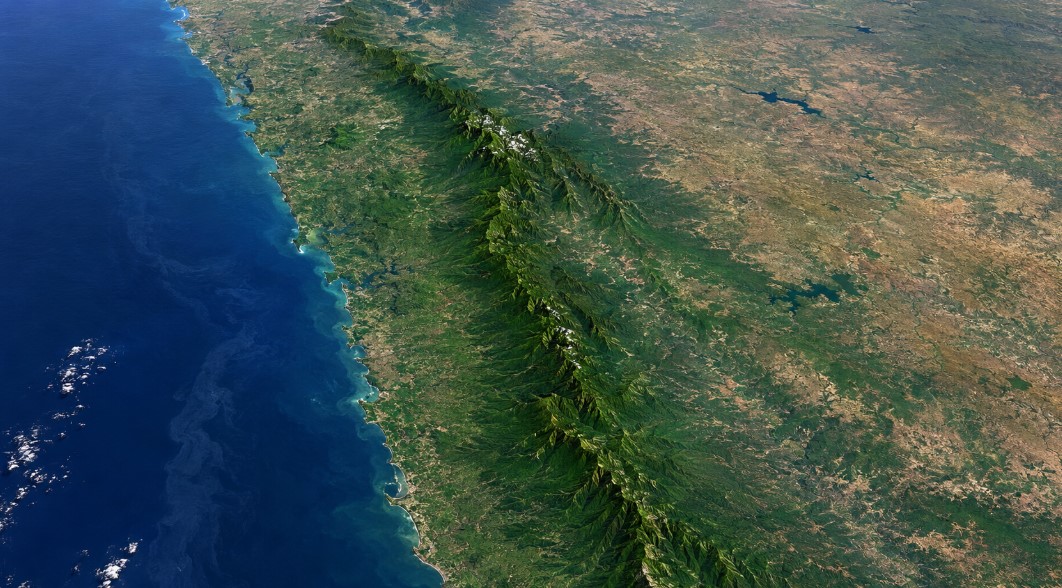
To truly understand the Sahyadri Mountain Range, we must first appreciate its scale and distribution. The range encompasses territories across six major Indian states: Kerala, Tamil Nadu, Karnataka, Goa, Maharashtra, and Gujarat. This impressive geographical spread demonstrates the range's continental importance and its role in connecting diverse ecological zones across southern and central India.
The physical characteristics of the Sahyadri Mountains are what make them uniquely significant. Unlike the Himalayan Mountains, which are relatively young geological formations, the Sahyadri Range represents an ancient mountain system. These mountains are primarily composed of a basement of crystalline rock, predominantly granite and gneiss, overlaid with sedimentary rocks. The elevation of the Sahyadri Range varies considerably, with peaks ranging from approximately 800 meters to over 2,600 meters above sea level. The highest peak, Dodabetta located in the Nilgiri Hills of Tamil Nadu, reaches an altitude of 2,636 meters, making it one of the prominent peaks in southern India.
The terrain is characterized by steep Western slopes descending abruptly toward the Arabian Sea, while the Eastern slopes show a more gradual descent toward the Deccan Plateau. This asymmetrical slope pattern has profound implications for rainfall distribution and vegetation patterns, which we will explore in the following sections.
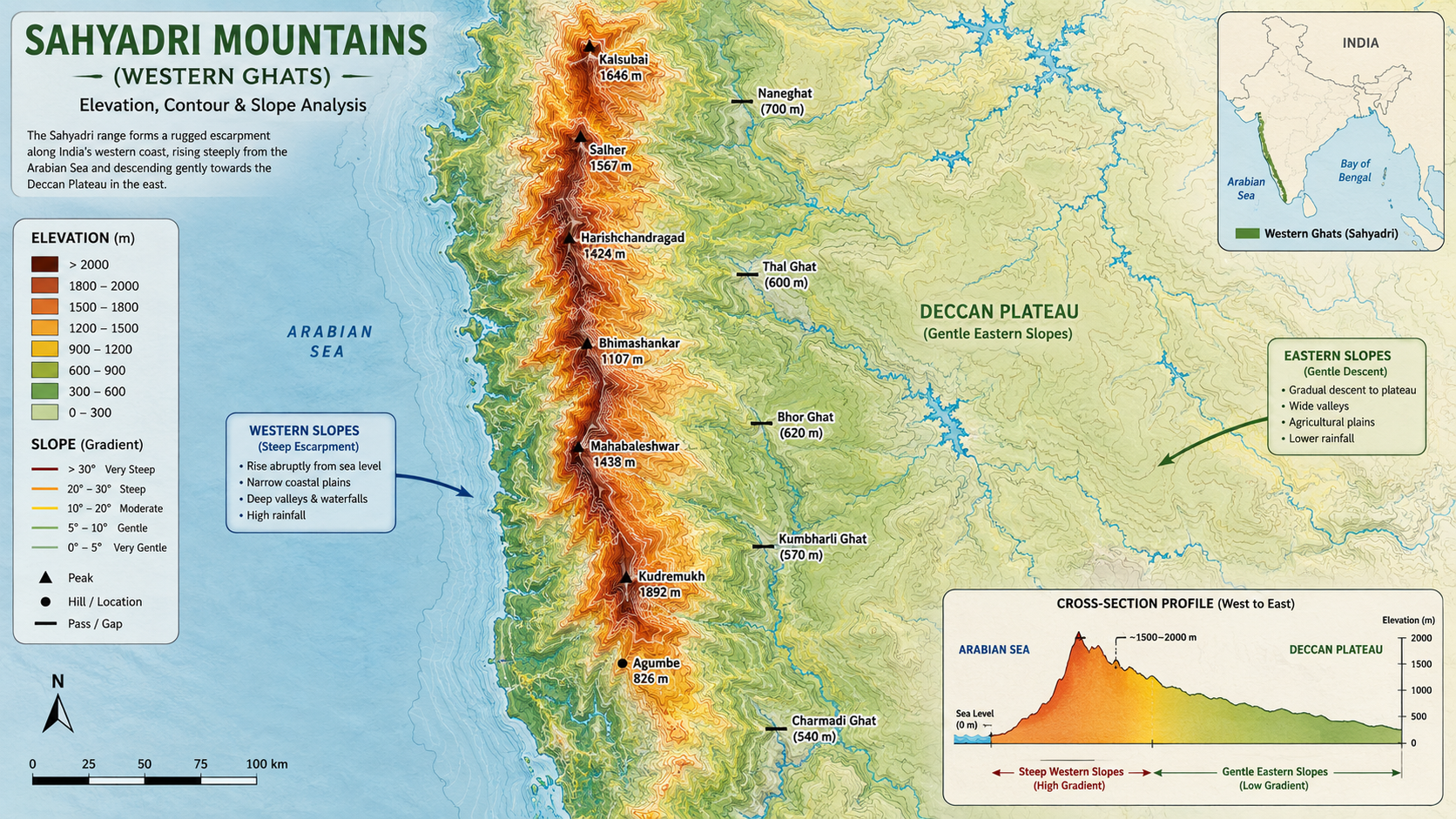
Climate and Meteorological Significance
The Sahyadri Mountain Range functions as a massive climatic boundary, creating one of the most dramatic rainfall variations found anywhere in India. The Western Ghats act as a formidable barrier to the moisture-laden monsoon winds that sweep in from the Arabian Sea during the Southwest monsoon season, typically from June to September.
When these wind currents encounter the steep Western slopes of the Sahyadri, they are forced upward, causing orographic precipitation—a phenomenon where air masses rise over mountainous terrain, cool down, and release their moisture as rain. This process creates a distinct "windward" and "leeward" effect that determines climatic patterns across the region.
The Western slopes, facing the Arabian Sea, receive exceptionally high rainfall, with some areas receiving between 3,000 to 7,000 millimeters of annual precipitation. In contrast, the Eastern slopes receive considerably less rainfall, often ranging from 500 to 1,000 millimeters annually. This dramatic difference creates what climatologists refer to as a rain shadow effect on the Deccan Plateau side, explaining why the plateau remains relatively arid despite the proximity to the Sahyadri Range.
The climate of the Sahyadri region varies significantly with altitude and location. Lower elevations experience a tropical monsoon climate with high temperatures and humidity, while higher elevations enjoy a more temperate climate with cooler temperatures and mist-laden conditions throughout the year. Many hill stations like Ooty, Coonoor, and Matheran have become popular destinations precisely because of this pleasant climate variation.
Biodiversity and Ecological Importance
Perhaps the most significant aspect of the Sahyadri Mountain Range is its extraordinary biodiversity and ecological importance. The range has been recognized as one of the world's most important biodiversity hotspots, earning the designation of a UNESCO World Heritage Site. This recognition underscores the region's unparalleled contribution to global conservation efforts.
The varied climate, altitude, and terrain of the Sahyadri have created diverse ecological niches that support an remarkable array of plant and animal species. The vegetation transitions from evergreen to deciduous forests as one moves eastward, creating distinct ecological zones. The Western slopes, benefiting from high rainfall, support lush tropical evergreen forests characterized by dense canopy coverage and high species diversity. Moving eastward, the vegetation transitions through semi-evergreen forests, deciduous forests, and finally dry deciduous forests on the Deccan Plateau.
The fauna of the Sahyadri Mountains includes numerous species found nowhere else on Earth. The range is home to the endangered Indian bison or gaur, the Nilgiri tahr, the lion-tailed macaque, and the elusive Indian tiger. Additionally, the region supports an impressive variety of amphibians, with numerous frog species found exclusively in the Western Ghats. The avifauna is equally impressive, with over 500 bird species recorded in the region, many of them migratory species that depend on the Sahyadri for their survival.
The botanical richness of the region is astounding, with estimates suggesting that approximately 4,000 to 5,000 species of flowering plants exist in the Western Ghats, with about 30 to 40 percent being endemic species found nowhere else globally. This concentration of endemic species makes the Sahyadri Mountains critical for global conservation efforts and botanical research.
Hydrological Significance and Water Resources
The Sahyadri Mountain Range plays a crucial role in the hydrology of the Indian subcontinent. The range acts as a watershed, with numerous rivers originating from its slopes and flowing toward both the Arabian Sea and the Bay of Bengal. These rivers are vital sources of freshwater for millions of people living in the surrounding regions.
Major rivers originating from the Sahyadri include the Godavari, Krishna, Kaveri, and Tungabhadra, which flow eastward toward the Bay of Bengal, and the Sharavati and Nethravati, which flow westward toward the Arabian Sea. These rivers not only provide irrigation and drinking water to millions but also generate significant hydroelectric power through dams and power stations constructed along their courses.
The groundwater aquifers recharged by the abundant rainfall in the Western Ghats serve as critical water sources for the surrounding semi-arid and arid regions. This hydrological role makes the preservation of the Sahyadri's natural cover essential for water security in the region.
Human Communities and Cultural Significance
Beyond its natural and scientific importance, the Sahyadri Mountain Range holds profound cultural and social significance for the people living within and around its boundaries. The range is home to numerous indigenous tribal communities who have developed unique cultural practices and knowledge systems adapted to the mountainous terrain.
These communities, including the Korava, Kurumba, and other tribal groups, possess traditional ecological knowledge that has enabled them to live in harmony with the Sahyadri ecosystem for centuries. Their agricultural practices, herbal medicine knowledge, and conservation methods offer valuable lessons for sustainable development and modern conservation strategies.
The Sahyadri region is also dotted with numerous temples, sacred groves, and historical sites that reflect the region's religious and cultural heritage. Sacred groves, known as "devrakhane" in Kannada, represent traditional conservation mechanisms where local communities have protected forests as sacred spaces, inadvertently preserving crucial biodiversity.
Contemporary Challenges and Conservation Efforts
Despite its ecological importance, the Sahyadri Mountain Range faces numerous threats from human activities, climate change, and unsustainable development practices. Deforestation for agricultural expansion, illegal mining, infrastructure development, and poaching pose significant challenges to the region's biodiversity.
Climate change presents an emerging threat, with shifting rainfall patterns and temperature increases affecting the delicate ecological balance that has existed for millennia. Conservation organizations, government agencies, and local communities are working collaboratively to protect the Sahyadri's fragile ecosystems through protected areas, national parks, and wildlife sanctuaries.
Major conservation initiatives include the implementation of Western Ghats Ecology Expert Panel recommendations and various state-level conservation programs aimed at sustainable management of the region's resources.
The Sahyadri Mountain Range represents far more than a geographical feature; it embodies the interconnectedness of ecological systems, climate patterns, water resources, and human cultures. Understanding the Sahyadri is essential for appreciating how natural systems function and why their preservation is crucial for future generations.
As we navigate the challenges of climate change and sustainable development, the Sahyadri Mountains remind us of nature's intricate balance and our responsibility as stewards of this magnificent ecosystem. Through informed conservation efforts, sustainable practices, and respect for traditional ecological knowledge, we can ensure that the "mountain of mountains" continues to be the green fortress of Western India for centuries to come.
Sample MCQ Questions
**
**
**
**
**
**
**
**
**
**
**
**