Introduction: Why Maharashtra's Dynastic History Matters
Maharashtra is not just India's second most populous state — it is a living museum of civilisations. Stretching across the Deccan Plateau, the Konkan coast, and the Vidarbha plateau, this land has been the epicentre of political power, trade, religion, art, and literature for over 3,000 years.
From the ancient Chalcolithic settlements of the Jorwe Culture (c. 1300–700 BCE) to the grand rise of the Maratha Empire in the 17th century, Maharashtra's soil has witnessed the footprints of emperors, saints, warriors, and scholars. For students preparing for MPSC, UPSC, Maharashtra State Board exams, and competitive tests, mastering the dynastic timeline of Maharashtra is absolutely non-negotiable.
In this article, we will walk through each major dynasty — era by era — with precision, clarity, and exam-oriented insights.
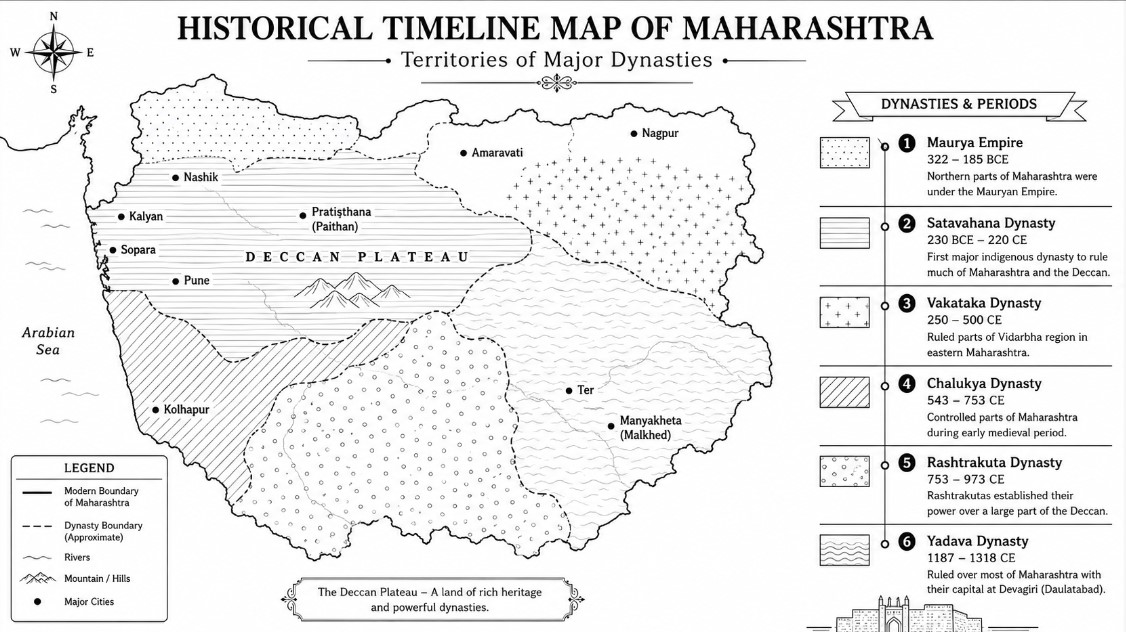
Pre-Dynastic Era: Jorwe Culture & Earliest Settlements (c. 1300–700 BCE)
Before powerful dynasties rose, Maharashtra was home to Chalcolithic (Copper Age) communities known as the Jorwe Culture. These were among the earliest settled farming communities of the Deccan.
Key Facts:
- Chalcolithic sites have been discovered throughout modern Maharashtra.
- The largest known settlement of this culture was at Daimabad — a Late Harappan site in the Ahmednagar district.
- Daimabad featured a mud fortification and an elliptical temple with fire pits, suggesting organised religious life.
- Evidence of planned rectangular houses and structured streets points to early urban sensibility.
- During the Late Harappan period, there was a significant migration of people from Gujarat to northern Maharashtra, indicating inter-regional cultural exchange.
Educator's Insight: The Jorwe Culture is Maharashtra's answer to the Indus Valley Civilisation — localised but equally significant for understanding early human settlements on the Deccan.
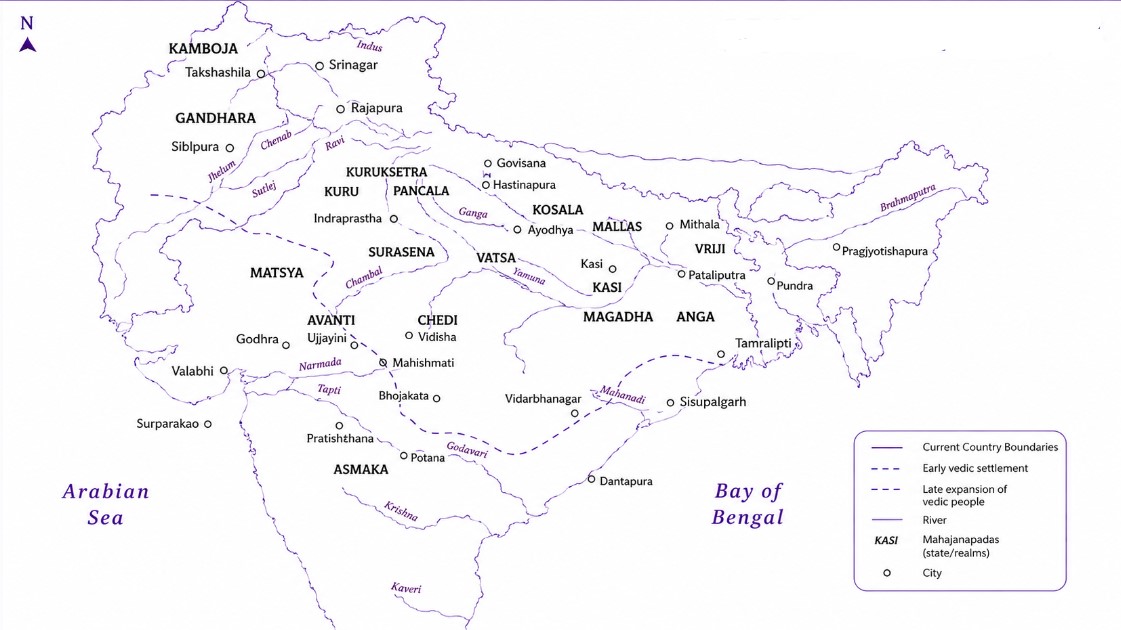
Dynasty 1: The Asmaka Kingdom — Maharashtra's Earliest Recorded Kingdom
The Asmaka (also written as Assaka) is considered one of the sixteen Mahajanapadas mentioned in ancient Buddhist and Jain texts. It is historically significant as the only Mahajanapada located south of the Vindhya mountains.
Capital & Location:
- Capital: Potana (identified with modern Bodhan in Telangana, bordering Maharashtra's Nanded district)
- Territory covered parts of present-day Marathwada region
Significance:
- The Asmaka kingdom is mentioned in the Pali texts and is associated with early Buddhist geography.
- It represents Maharashtra's first entry into the recorded political history of the Indian subcontinent.
Dynasty 2: The Maurya Empire (4th–2nd Century BCE)
Arrival of Imperial Power
Maharashtra came under the umbrella of the Maurya Empire during the 4th and 3rd centuries BCE. Emperor Chandragupta Maurya first unified the subcontinent, and his grandson Ashoka extended Mauryan influence deep into the Deccan.
Key Evidence in Maharashtra:
- One of Ashoka's Major Rock Edicts has been found at Sopara (near present-day Mumbai/Palghar district) — a powerful testimony to Mauryan presence in the region.
- Buddhism flourished under Mauryan patronage, and traders served as primary patrons of early Buddhist monasteries in the Deccan.
Trade Connections:
- During this period, Maharashtra was connected to international trade networks — first with the Greeks and later with the Roman Empire.
- This vibrant trade boosted the growth of coastal and inland cities.
Educator's Insight: Remember — the Sopara (Shurparaka) rock edict is the southwesternmost Ashokan inscription. It is a favourite MPSC question.
Dynasty 3: The Satavahana Dynasty (c. 230 BCE – 220 CE)
The Golden Age of Ancient Maharashtra
The Satavahana dynasty is arguably the most important ancient dynasty for Maharashtra's identity. They ruled the region for nearly 400 years — making them the longest-reigning ancient power of the Deccan.
Origin & Rise:
- Around 230 BCE, the Satavahanas rose to power as the Mauryan Empire declined.
- They established their control over the Deccan, particularly the Godavari and Krishna river valleys.
Notable Rulers:
| Ruler | Contribution |
|---|---|
| Simuka | Founder of the dynasty |
| Satakarni I | Expanded the kingdom; performed Vedic sacrifices |
| Gautamiputra Satakarni | Greatest Satavahana ruler; defeated Scythian (Shaka) invaders |
| Vashishthiputra Pulumayi | Extended trade with Rome |
Administrative & Cultural Contributions:
- Used Maharashtri Prakrit as their official language — a direct linguistic ancestor of modern Marathi.
- Coins and Buddhist monastery inscriptions were written in Prakrit.
- They were great patrons of Buddhism and Brahminism simultaneously.
- The famous Ajanta Cave early paintings trace their roots to this era.
Educator's Insight: Gautamiputra Satakarni's title was "Eka Brahmanah" (the unique Brahmin champion) — he is celebrated for expelling the Western Satraps (Shakas) from the Deccan. This is critical for exams!
Dynasty 4: The Vakataka Dynasty (c. 250–470 CE)
The Cultural Bridge Between Ancient and Medieval
Following the Satavahanas, the Vakataka dynasty emerged as the dominant power in the Deccan. They are especially celebrated for their patronage of art, architecture, and literature.
Key Facts:
- Ruled from approximately 250 CE to 470 CE
- Had close matrimonial alliances with the Gupta dynasty of North India (Chandragupta II's daughter Prabhavati Gupta was a Vakataka queen)
- Under Vakataka patronage, the Ajanta Caves reached their artistic zenith — the cave paintings of Ajanta (Phases 2 onwards) are directly attributed to this era.
Capital:
- Nandivardhana (near Nagpur) and Vatsagulma (modern Washim) were the two branches of the Vakataka kingdom.
{Image context: The interior of Ajanta Cave No. 1 or Cave No. 17 showing the exquisite Vakataka-era murals depicting Bodhisattva Padmapani — the most iconic UNESCO-recognised Buddhist paintings in India}
Educator's Insight: Ajanta Caves are a UNESCO World Heritage Site. Questions often ask: "Which dynasty is associated with the classical phase of Ajanta paintings?" — Answer: Vakataka.
Dynasty 5: The Chalukya Dynasty (6th–8th Century CE)
Warriors of the Deccan
The Chalukya dynasty of Vatapi (Badami) was one of the most powerful medieval Indian empires. They ruled Maharashtra from the 6th century to 8th century CE.
Key Rulers:
| Ruler | Achievement |
|---|---|
| Pulakeshin I | Founded the Chalukya dynasty at Vatapi (Badami) |
| Pulakeshin II | Defeated Emperor Harsha of Kannauj in 618 CE — the only South Indian king to stop a North Indian imperial expansion |
| Vikramaditya II | Defeated Arab invaders in the 8th century |
Why Pulakeshin II Matters for Maharashtra:
- His Aihole Inscription (634 CE) — composed by the poet Ravikirti — mentions the name "Maharashtra" for the very first time, referring to sovereignty over "the three Maharashtras with their 99,000 villages."
- This makes the Aihole Inscription the earliest epigraphic evidence for the name "Maharashtra."
Cultural Legacy:
- The magnificent Ellora Caves (Kailasa Temple) and the cave temples of Badami, Aihole, and Pattadakal were developed under Chalukya patronage.
Dynasty 6: The Rashtrakuta Dynasty (8th–10th Century CE)
Maharashtra's Most Powerful Ancient Empire
The Rashtrakuta dynasty ruled Maharashtra and much of the Deccan from the 8th to 10th century CE. At their peak, they were considered one of the four great imperial powers of the medieval world.
Extent of Power:
- The Arab traveller Sulaiman (9th century CE) described Rashtrakuta ruler Amoghavarsha I as one of the four great kings of the world — placing him alongside the Caliphate of Baghdad, the Byzantine Emperor, and the Tang Emperor of China.
Key Rulers:
| Ruler | Achievement |
|---|---|
| Dantidurga | Founded the dynasty by overthrowing the Chalukyas |
| Krishna I | Built the magnificent Kailasa Temple at Ellora (Cave 16) |
| Dhruva | First Deccan king to campaign in North India |
| Amoghavarsha I | Scholar-king; authored Kavirajamarga (first Kannada literary text) |
| Indra III | Sacked the Gurjara-Pratihara capital Kannauj |
Cultural Contributions:
- The Kailasa Temple at Ellora — carved out of a single mountain of basalt rock — is considered the greatest rock-cut monument in the world and was built under Rashtrakuta patronage.
- Their capital was at Manyakheta (Malkhed) in modern Karnataka, but their cultural sphere was deeply embedded in Maharashtra.
Educator's Insight: Remember: Krishna I → Kailasa Temple. This one fact appears in almost every Maharashtra competitive exam. Do not confuse with Ashoka's works!
Dynasty 7: The Shilahara Dynasty (800–1200 CE)
Guardians of the Konkan
Between 800 CE and 1200 CE, the Shilahara dynasty ruled parts of Western Maharashtra, particularly the Konkan coast. They operated in three branches:
- North Konkan branch (ruling areas around Thane and Mumbai)
- South Konkan branch (ruling areas around Goa's borders)
- Kolhapur branch (ruling southern Maharashtra)
- At different times, the Shilaharas served as vassals (feudatories) of either the Rashtrakutas or the Chalukyas.
- They were great patrons of temple architecture and constructed several Shiva temples along the Konkan coast.
Dynasty 8: The Seuna (Yadava) Dynasty (c. 850–1317 CE)
Maharashtra's Last Great Indigenous Dynasty
The Yadava dynasty (also called Seuna Yadavas) represents the last great indigenous Hindu dynasty of Maharashtra before the Islamic invasions. They ruled from Devagiri (modern-day Daulatabad, near Aurangabad).
Rise to Power:
- Originally feudatories of the Western Chalukyas, the Yadavas declared independence around the mid-12th century CE as Chalukya power declined.
- Their peak power extended from the Tungabhadra River (south) to the Narmada River (north).
Key Rulers:
| Ruler | Achievement |
|---|---|
| Dridhaprahara | Earliest historically attested ruler (860–880 CE) |
| Bhillama V | Declared independence; established Devagiri as capital |
| Singhana (Singhana II) | Greatest ruler; expanded the empire; patronised Marathi literature |
| Ramachandra | Last significant ruler before Delhi Sultanate invasion |
Linguistic & Literary Revolution:
- Earlier Yadava rulers used Sanskrit as the court language.
- Under Singhana, Marathi became the official court language — a landmark moment in the history of the Marathi language.
- Devagiri became a magnet for Marathi scholars and poets. The origin and growth of Marathi literature is directly linked to the Yadava dynasty.
- Saints like Dnyaneshwar (who wrote Dnyaneshwari — a Marathi commentary on the Bhagavad Gita in 1290 CE) flourished during this period.
Fall of the Yadavas:
- In the early 14th century, the Delhi Sultanate ruler Ala-ud-din Khalji invaded and overthrew the Yadava dynasty.
- This marked the end of over 1,500 years of indigenous dynasty rule over Maharashtra.
Educator's Insight: The Dnyaneshwari (1290 CE) is the oldest and most celebrated text of Marathi literature. It was composed during the Yadava period. Questions on "when did Marathi become the court language?" answer: Yadava dynasty under Singhana.
Quick Reference: Dynasty Timeline of Maharashtra
| Dynasty | Period | Capital | Key Contribution |
|---|---|---|---|
| Asmaka | Pre-600 BCE | Potana | Oldest Mahajanapada of Deccan |
| Maurya | 4th–2nd BCE | Pataliputra | Rock Edict at Sopara; Buddhism |
| Satavahana | 230 BCE–220 CE | Pratishthan (Paithan) | Maharashtri Prakrit; trade |
| Vakataka | 250–470 CE | Nandivardhana | Ajanta paintings |
| Chalukya | 6th–8th CE | Vatapi (Badami) | Name "Maharashtra"; Ellora |
| Rashtrakuta | 8th–10th CE | Manyakheta | Kailasa Temple; world power |
| Shilahara | 800–1200 CE | Thane/Kolhapur | Konkan temples |
| Yadava | 850–1317 CE | Devagiri | Marathi as court language |
Practice MCQs: Ancient Dynasties of Maharashtra
Summary: Key Takeaways for Competitive Exams
- Jorwe Culture (1300–700 BCE) → Earliest Chalcolithic settlement; Daimabad is the largest site.
- Asmaka Kingdom → Only Mahajanapada south of the Vindhyas; part of Marathwada region.
- Maurya Empire → Ashoka's Rock Edict at Sopara (near Mumbai); Buddhism flourished.
- Satavahana (230 BCE–220 CE) → Used Maharashtri Prakrit; Gautamiputra Satakarni defeated Shakas.
- Vakataka (250–470 CE) → Patrons of Ajanta Cave paintings.
- Chalukya (6th–8th CE) → Pulakeshin II first used the word "Maharashtra" in the Aihole Inscription.
- Rashtrakuta (8th–10th CE) → Krishna I built Kailasa Temple (Ellora); Amoghavarsha was a world-class ruler.
- Yadava/Seuna (850–1317 CE) → Marathi became the court language under Singhana; capital at Devagiri (Daulatabad).